- 1. The octave roller on the back is hard to operate.
- 2. The volume is too low!
- 3. Is the touch sensor unreliable?
- 4. The sound is weak!
Let’s tackle these one by one.
First, the “octave roller.”
This is unique to the EWI, and I struggled with it quite a bit at first, too.
It’s similar to how many people who give up on the guitar say, “I couldn’t fret the F chord, so I quit.”
The key to mastering the F chord on a guitar is to press down on all the strings with your left index finger—not with the pad of your finger, but by pressing with the side of your finger. You can master the EWI’s octave roller using the same technique.
Simply angle your thumb sideways when pressing the roller. Try pressing between the rollers with the side of your thumb, rather than the pad. This will drastically reduce your mistakes.
Next, regarding point 2, “The sound is too quiet”—please just accept this. That’s just how it is.
However, you can make it slightly louder by increasing the sensitivity of the breath sensor.
Press the Global button ⇒ Select “Breath Sensor” ⇒ Press the encoder knob to select ⇒ Set it slightly higher than the default and confirm. I set '42'.


Press the Global button ⇒ Select “Breath Sensor” ⇒ Press the encoder knob to select ⇒ Set it slightly higher than the default and confirm.
Regarding point 3, “the touch sensor is unstable”—isn’t this referring to the sound being played a half-step off pitch for no apparent reason?
This is caused by the K10 key, a new addition to the EWI-SOLO. The culprit is the small bar protruding to the right, located five keys down from the note keys. Touching this raises the pitch by a half-step, but since this key doesn’t exist on the 4000 or 5000 models, experienced EWI players are bound to be confused by it.
If the inside of your finger accidentally brushes against it, the pitch rises by a half-step, leading you to mistakenly believe that the key response is unstable.
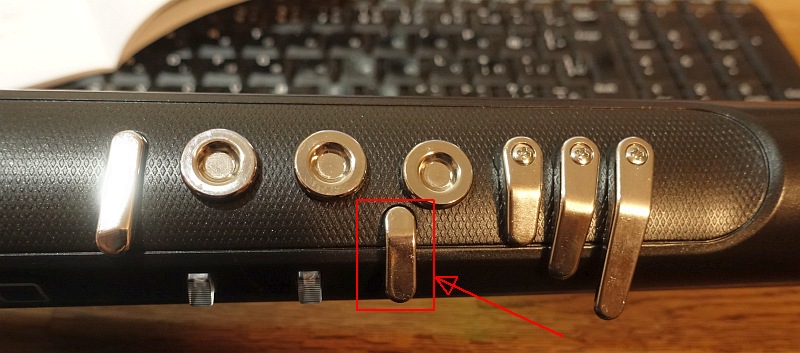
↑The EWI4000S and EWI5000 do not have this key.
Press the Global button ⇒ Key Action ⇒ Press the encoder knob to select [Enable K10] ⇒ Set it to OFF and confirm
As for point 4, “the sound is weak,” you’ll have to accept that to some extent, but you can improve it by applying reverb with FX or mixing in a sound that’s been delayed just a little bit using Delay.
Once you’ve made your adjustments, be sure to SAVE that sound.
Press the Save button ⇒ Select a slot from the Favorite list (FAV1–4) ⇒ Turn the encoder knob to select “Empty” ⇒ Confirm with “YES”
It’s easy to assume that simply pressing the SAVE button twice will save the settings, but that’s not the case, so be careful.

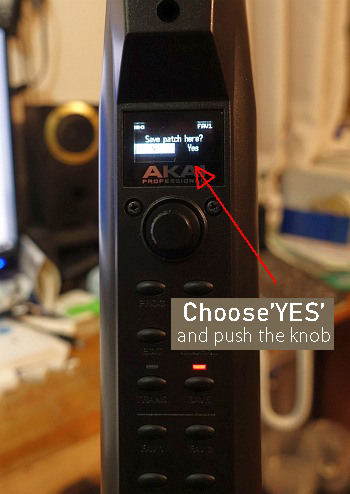
Just doing this should make the sound feel slightly better than the default.
Each of the four Favorite banks has four memory slots, so you can save up to 16 presets in total.
You can instantly recall saved presets using the four Favorite buttons and the encoder knob.
While you can configure all these settings directly on the unit itself, installing the PC software called “EWI-SOLO Editor” allows you to adjust settings while viewing them on your PC’s larger screen.
Since this editor software is also required for firmware updates, be sure to install it.
Download links are available at akaipro.com (Windows and Mac versions).

↑A screenshot of the editor software. The K10 key is turned off.
Also, if you accept that the built-in speakers are meant for indoor practice and connect to external speakers to crank up the volume when you’re really getting into a performance, the sound will be completely different.
I recommend JBL Bluetooth speakers—they’re small and battery-powered. They deliver more than enough power for a home party.
Similar models made in China are also available at low prices.
Other items you might want to pick up include a case and a neck strap.
For the case, go for a multipurpose one that can hold a stand and a music stand; choosing one with an inner diameter of 80 cm works well.
The included neck strap is far too flimsy, so feel free to choose from the various options available specifically for saxophones.
Digital Wabi-Sabi 3 -A Soul Inhabits EWI-
Digital Wabi-Sabi 2 -My Mouse Plays The Piano-
Digital Wabi-Sabi -As Easy As EWI-
 previous
 next
